
The architecture of the Palau de la Musica Catalana
UNESCO World Heritage Site since 1997 - Lluís Domènech i Montaner's masterpiece of Catalan Modernism. Stained glass dome, mosaic columns and sculptural stage, built 1905-1908.
A masterpiece of Catalan modernism
The Palau de la Musica Catalana is considered one of the most representative buildings of Catalan Art Nouveau - the independent Catalan variant of European Art Nouveau, known as Modernisme Català. Built between 1905 and 1908 by architect Lluís Domènech i Montaner for the Orfeó Català choir association, the building combines architecture, sculpture, mosaics, glass art and ironwork to create a unique work of art. In 1997, the Palau was declared a UNESCO World Heritage Site.
While Antoni Gaudí is considered the most famous representative of Modernisme today, Domènech i Montaner was at least as influential during his lifetime - as an architect, university lecturer and politician. His Palau is still considered the only concert hall in Europe that can be lit exclusively by natural light, thanks to the spectacular inverted stained glass dome in the center of the ceiling.
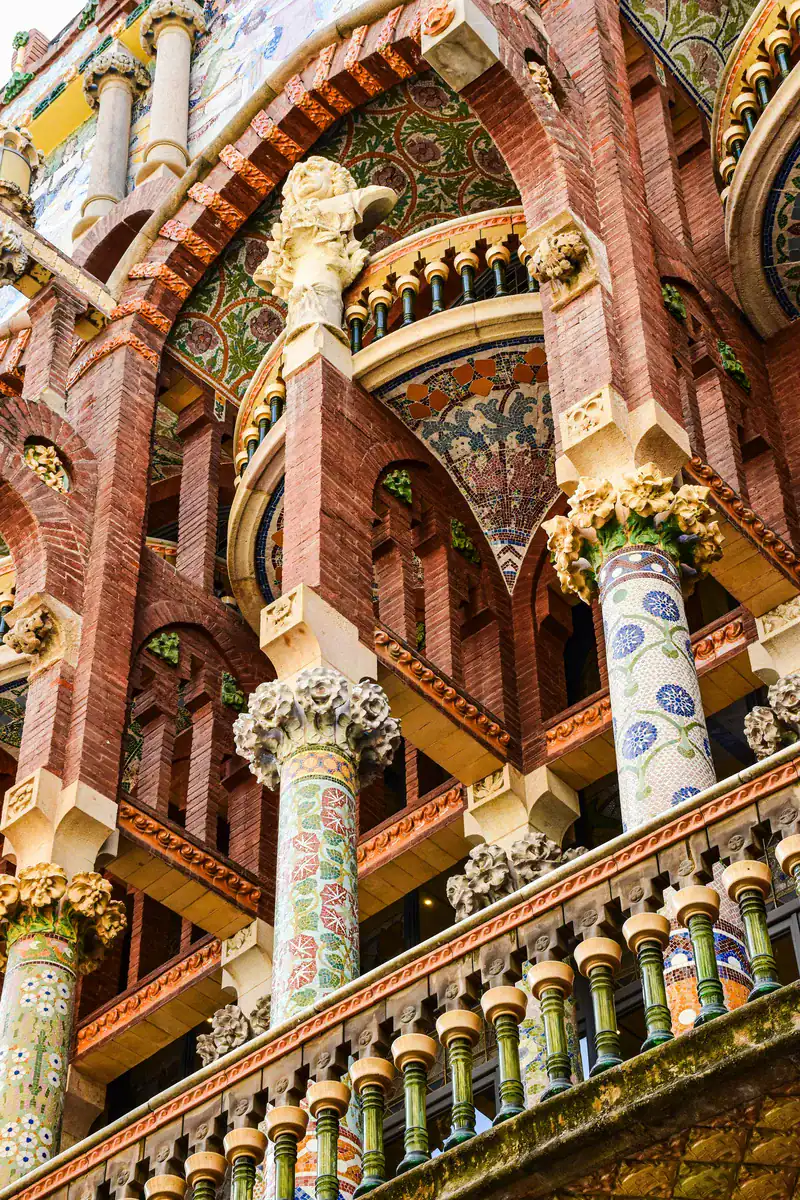
The building also stands for the so-called Renaixença - the Catalan cultural renaissance of the late 19th century, in which Barcelona consciously set itself apart from the centralist Spanish tradition and sought its own artistic expression. Every detail of the Palau - from the sculptures of the muses on the stage to the floral ceramic motifs on the façade - tells of this cultural self-assertion.
The iconic architectural elements
Three features make the Palau a unique building in world architecture.
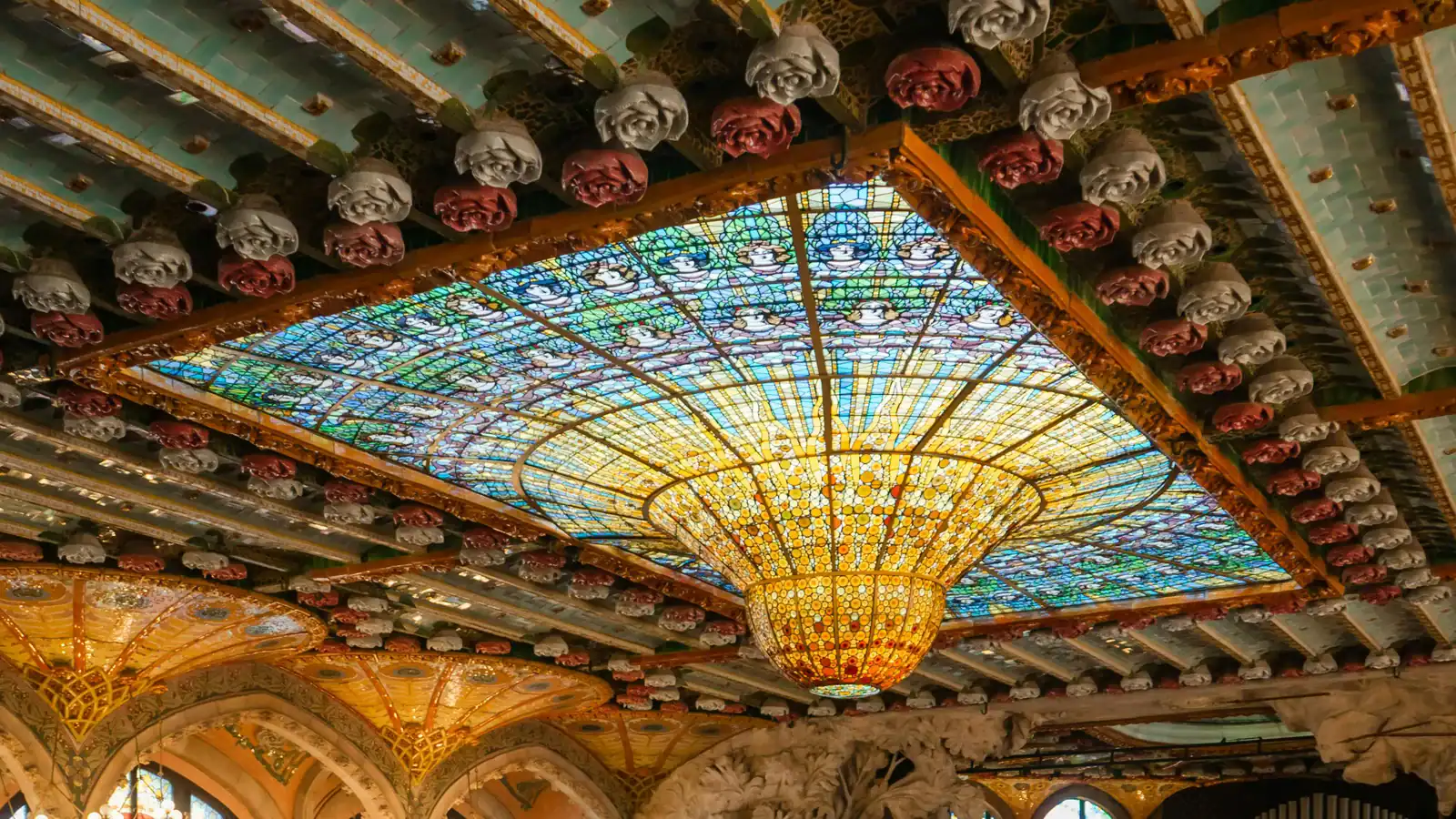
The inverted stained glass dome
A teardrop-shaped glass dome in blue and gold hangs in the center of the ceiling - a symbol of the sun shining down into the concert hall. Created by glass artist Antoni Rigalt, it is the centerpiece of the Palau and makes the hall the only one in Europe that can be lit exclusively by daylight during the day.
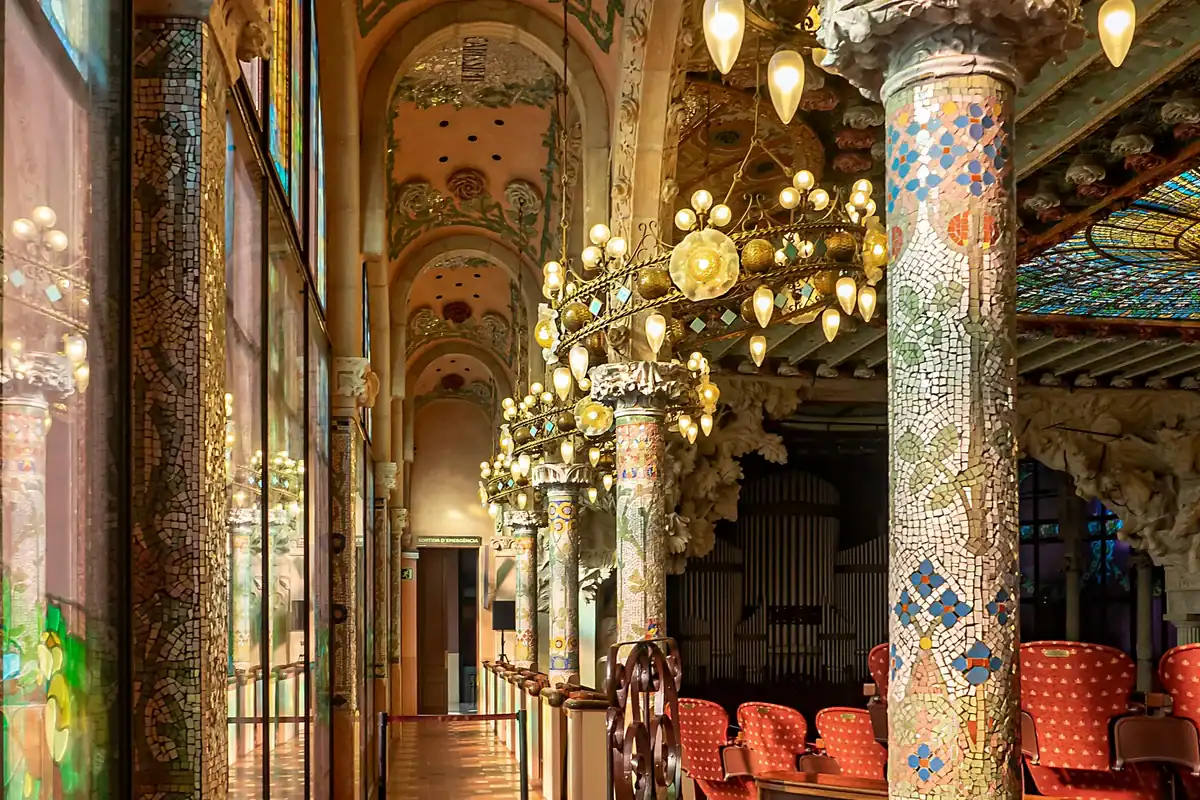
The mosaic columns
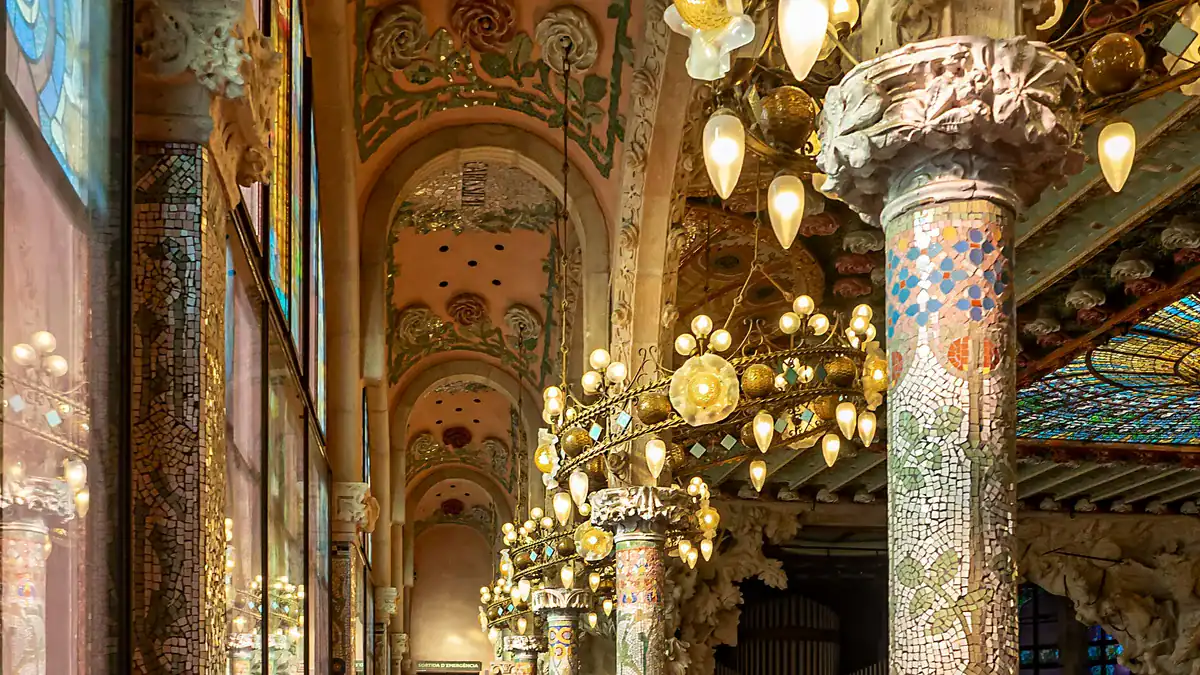
Each of the 40 columns is unique - covered with the typical Catalan trencadís technique made from fragments of painted ceramics. Floral patterns, roses and geometric ornaments tell a different story in each column. In the coffered foyer and in the side corridor, the columns bathe the room in colored light.
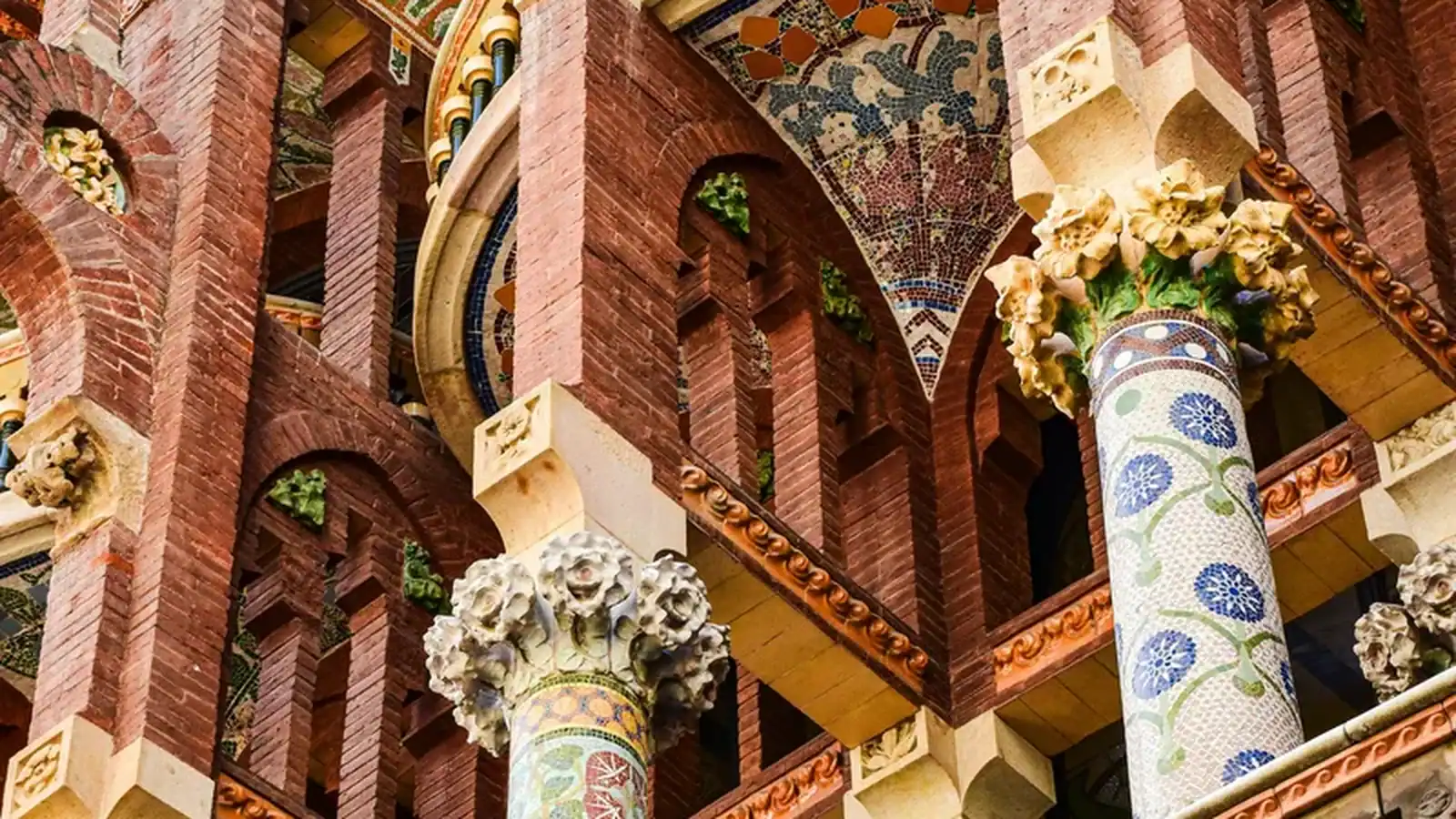
Sculpture & facade
The stage is flanked by two monumental sculptural groups: on the left Ludwig van Beethoven under the Ride of the Valkyries, on the right a bust of the Catalan composer Anselm Clavé with the tree „La Flor de Maig“. On the back wall of the stage, 18 life-size muses, half mosaic, half sculpture - designed by Eusebi Arnau and Lluís Bru.

Building history at a glance
From the founding of the Orfeó Català to the UNESCO World Heritage Site - the most important stages of the Palau.
Foundation of the Orfeó Català
The composers Lluís Millet and Amadeu Vives found the Catalan choral society Orfeó Català - the catalyst for the later idea of a dedicated concert hall for Catalan music culture.
Buying a plot of land in the Ribera district
The Orfeó Català acquires a corner plot in the middle of the historic La Ribera district. Lluís Domènech i Montaner - already an established architect and director of the Escola d'Arquitectura - is commissioned with the design.
Start of construction
On April 23, 1905, the day of Saint George (Sant Jordi), the foundation stone is laid. Domènech i Montaner works with a team of the best artisans in Barcelona: Eusebi Arnau (sculpture), Lluís Bru (mosaics) and Antoni Rigalt (glass art).
Inauguration on February 9
After just two and a half years of construction, the Palau opens its doors - a masterpiece of urban planning given the narrow streets of the Ribera. It is immediately celebrated as the most modern concert hall in Europe.
Designation as a national monument
The Spanish government recognizes the Palau as a national historical-artistic monument - a prerequisite for later UNESCO status and for public restoration funds.
Major restoration by Óscar Tusquets
Catalan architect Óscar Tusquets carefully restores the Palau and adds a new stage area. Mosaic, glass and sculpture are restored by specialist companies after years of painstaking work.
Inclusion in the UNESCO World Heritage List
UNESCO inscribes the Palau de la Musica Catalana together with the Hospital de Sant Pau - also by Domènech i Montaner - on the World Heritage List. Reason: unique testimony to Catalan Modernisme.
Extension: Petit Palau & new building
Óscar Tusquets designed a modern extension with a new entrance plaza and a second, smaller hall - the Petit Palau. The historic concert hall remains unchanged; the extension creates space for chamber concerts and visitor tours.
Lluís Domènech i Montaner (1850-1923)
Architect, university lecturer, politician - and one of the three main representatives of Catalan Modernisme alongside Antoni Gaudí and Josep Puig i Cadafalch.
Born in Barcelona in 1850, Domènech i Montaner initially studied natural sciences in Madrid before switching to architecture. From 1875, he taught at the Escola d'Arquitectura in Barcelona and later became its director - in this role, he influenced an entire generation of Catalan architects, including the young Antoni Gaudí, who was one of his students.
As a convinced Catalanist, Domènech i Montaner was politically committed to the cultural independence of Catalonia. He was one of the authors of the Bases de Manresa (1892), an early manifesto of Catalan regionalism. This political stance is reflected in his buildings: the Catalan flag appears on the façade of the Palau, as well as the coat of arms of Barcelona and motifs from Catalan folk music.
Two of his works - the Palau de la Musica Catalana and the Hospital de Sant Pau - are now UNESCO World Heritage Sites. With hotels such as the Casa Fuster, the Castell dels Tres Dragons and numerous private houses, he is considered the architect who developed the language of Modernisme the furthest in terms of technology and design.
All three UNESCO Modernisme works in one passport
The Domènech i Montaner Pass bundles three of the architect's works into one combined ticket - ideal for architecture fans who want to experience Modernisme in all its depth.
Palau de la Musica Catalana
Concert hall and masterpiece of glass and mosaic art. Built in 1905-1908 for the Orfeó Català. UNESCO World Heritage Site since 1997.
Hospital de Sant Pau
Former clinic complex of 27 Art Nouveau pavilions, built between 1902 and 1930, the largest Art Nouveau complex in Europe and also a UNESCO World Heritage Site since 1997.
Casa Fuster
Residential building built in 1908-1911 on Passeig de Gràcia, now a 5-star hotel. One of Domènech's last Modernisme works, with a striking corner tower.
Frequently asked questions about the architecture of the Palau
Lluís Domènech i Montaner (1850-1923) was a Catalan architect, university lecturer and politician. Alongside Antoni Gaudí and Josep Puig i Cadafalch, he is considered one of the three main representatives of Catalan Modernism. Two of his works are UNESCO World Heritage Sites: the Palau de la Musica Catalana and the Hospital de Sant Pau. Other well-known buildings include the Casa Fuster, the Castell dels Tres Dragons and the Hotel Espanya.
Modernisme Català is the Catalan variant of European Art Nouveau or Art Nouveau, which flourished in Barcelona between around 1880 and 1914. It is characterized by floral ornamentation, coloured ceramics (trencadís), wrought ironwork, curved shapes and the integration of traditional Catalan craft techniques. The Palau de la Musica is considered one of the purest examples of this style.
The Palau de la Musica Catalana was inscribed on the UNESCO World Heritage List in 1997 together with the Hospital de Sant Pau. The reason given was that both buildings are unique examples of Catalan modernism and urban concert hall construction from around 1900. Both works were designed by the same architect: Lluís Domènech i Montaner.
While Gaudí worked with curved, organic forms and symbolic natural architecture (Sagrada Familia, Park Güell), Domènech i Montaner followed a more rational, historically inspired approach. His buildings have clear geometric structures and emphasize craftsmanship - mosaic, glass, ironwork and sculpture - more than the overall sculptural form. Incidentally, Gaudí was a student of Domènech at the Escola d'Arquitectura.
The architecture can be discovered in three ways: self-guided with a brochure, with an audio guide (own speed) or on a guided tour with a professional guide (additional background information and access to otherwise closed areas). A detailed comparison of all three options: Guided tours of the Palau de la Musica
Domènech i Montaner worked with the best craftsmen in Barcelona: Eusebi Arnau created the sculptures (including the muses on the back wall of the stage), Lluís Bru and Mario Maragliano the mosaics, Antoni Rigalt the stained glass work including the famous dome and the Esteve Andorrà workshop the wrought iron work. The dominant building materials are red brick, colored ceramics, wrought iron and glass.
Yes, the Domènech i Montaner Pass brings together three of the architect's works: Palau de la Musica, Hospital de Sant Pau and Casa Fuster. All three are centrally located in Barcelona and can easily be visited in one or two days. All combined offers at a glance: Combi-tickets on the homepage
More about the Palau de la Musica
Experience Domènech's masterpiece with your own eyes
A description hides only a fraction of the actual impression. Secure your ticket now and discover the architecture of the Palau de la Musica Catalana - with free cancellation up to 24 hours in advance.